

XAT Mock Analysis Strategy: How to Analyse XAT Mocks Effectively
Preparing for the Xavier Aptitude Test requires more than completing the syllabus. Many students practice questions regularly but struggle to improve their scores. One of the most effective ways to improve performance is by taking mock tests and analysing them correctly
.
Mock tests simulate the real exam environment and help aspirants develop the ability to think under pressure. But simply attempting mocks is not enough. The real improvement comes from systematic analysis, strategy adjustment, and consistent tracking of performance.
This guide explains how to use mock tests effectively, analyse your performance, and improve your XAT score quickly.
How to Analyse XAT Mocks Effectively
- Review overall performance: Check your score, attempts, and accuracy. Compare with previous mocks to see if you’re improving or plateauing.
- Analyse time distribution: Identify which section consumed the most time and whether you rushed any section. Look for questions where you got stuck unnecessarily.
- Focus on accuracy: Break mistakes into types conceptual errors, misreading, calculation mistakes, or guesswork. Work on reducing repeated errors.
- Evaluate question selection: Check if you attempted easy/moderate questions first. Avoid spending too much time on lengthy or low-ROI questions.
- Do section-wise analysis:
- Decision Making → Were your answers balanced and practical?
- Verbal → Did you misinterpret passages or rush answers?
- Quant → Were errors due to concepts or calculations?
- Track performance over mocks: Maintain a simple tracker or error log to identify patterns across 10–15 tests. This helps in spotting consistent weak areas.
- Measure improvement metrics: Focus on improving accuracy %, reducing time per question, and better question selection not just increasing attempts.
- Convert analysis into action: Revise weak topics, practice similar questions, and adjust your strategy before the next mock.
Sources for XAT Mock Tests
Students preparing for XAT can access mock tests from multiple sources.
The most reliable mock tests are the ones released by the . These tests closely replicate the actual exam pattern and difficulty level.
Aspirants should always attempt official mocks because they provide the most accurate simulation of the real exam.
Free Online Mock Tests
Several educational platforms provide free mock tests that allow students to:
-
understand the exam format
-
practice time management
-
experience full-length test conditions
These are useful especially during the early stages of preparation.
Coaching Mock Test Series
Many students also use paid mock test series offered by coaching institutes because they provide:
-
full-length practice tests
-
detailed performance analysis
-
section-wise score breakdown
Check out Previous year papers (2014-2024) with solutions this can significantly improve exam readiness.
XAT Score vs Percentile (Last 5 Years Trend)
| Year | 99 Percentile | 97 Percentile | 95 Percentile | 90 Percentile |
|---|---|---|---|---|
| 2025 | 38 – 40 | ~34–35 | ~32 | ~28 |
| 2024 | 36 – 38 | ~35+ | ~30+ | ~27–30 |
| 2023 | 43 – 46 | ~41 | ~39 | ~34–35 |
| 2022 | ~37 | ~32–33 | ~29–30 | ~22–27 |
| 2021 | ~37 | ~33 | ~31 | ~27 |
XAT Mock Analysis Strategy for 99 Percentile
Once you complete a mock test for the Xavier Aptitude Test, the most important step is analysing each section carefully. Section-wise analysis helps you identify patterns of mistakes, weak question types, and inefficient strategies.
Instead of only checking the score, focus on how you attempted each section.
1) Decision Making Section Analysis
Decision Making is one of the most distinctive parts of the Xavier Aptitude Test. It evaluates how well you analyse real-life situations involving ethical dilemmas, business problems, and stakeholder conflicts.
During mock analysis, ask yourself:
-
Did I understand the core problem in the caselet before looking at options?
-
Did I consider all stakeholders involved such as employees, management, and customers?
-
Did I select the option that is ethical and practical, not just logically correct?
-
Did I spend too much time reading long caselets?
Also identify the type of DM questions where you struggled, such as:
-
ethical dilemma cases
-
profit vs ethics scenarios
-
HR or management conflicts
If you repeatedly struggle with a certain format, practice similar caselets and study why the correct option works better than the others.
2) Verbal Ability and Reading Comprehension Analysis
For Verbal Ability and Reading Comprehension, the goal is to analyse reading efficiency and accuracy.
After each mock, review:
-
Which passages took the most time to read and solve
-
Whether incorrect answers came from misinterpreting the passage
-
Whether you rushed through options without revisiting key lines in the passage
-
Whether you spent too long on a difficult passage instead of skipping it
Practical improvements include:
-
Attempting shorter or easier passages first
-
Marking important lines while reading
-
Avoiding assumption-based answers not supported by the passage
3) Quantitative Ability and Data Interpretation Analysis
For Quantitative Ability and Data Interpretation, mock analysis should focus on question selection and calculation efficiency.
Review the following after every mock:
-
Which topics caused the maximum errors
-
Whether mistakes were due to concept gaps or careless calculations
-
Which questions took more than 2-3 minutes to solve
-
Whether you attempted questions in the optimal order
Many students lose marks because they start the section with difficult or calculation-heavy problems.
Overall Mock Test Analysis
After analysing individual sections, the next step is reviewing your overall test performance.
Focus on factors like time usage, accuracy, question selection, and strategy effectiveness.
1. Review Time Usage
Start by checking how your time was distributed across sections.
Ask yourself:
-
Which section consumed the maximum time?
-
Did I rush through the final section because I overspent time earlier?
-
Were there questions where I got stuck unnecessarily?
Understanding time allocation helps refine your test-taking strategy for future mocks.
2. Evaluate Accuracy
Accuracy plays a major role in improving scores in the Xavier Aptitude Test because incorrect answers lead to negative marking.
During analysis, check:
-
Which section had the lowest accuracy
-
Whether mistakes came from concept gaps, misreading questions, or calculation errors
-
Whether you guessed answers without proper elimination
Improving accuracy often leads to faster score improvement than increasing attempts.
3. Track Performance Over Time
One of the most effective ways to improve mock performance is tracking results across multiple tests.
Instead of analysing a single mock in isolation, monitor trends such as:
-
whether your overall score is improving
-
which sections show consistent improvement or decline
-
whether your accuracy percentage is increasing
Tracking performance across 10–15 mocks helps identify stable strengths and recurring weaknesses, allowing you to focus preparation where it matters most.
Tools to Track Mock Performance
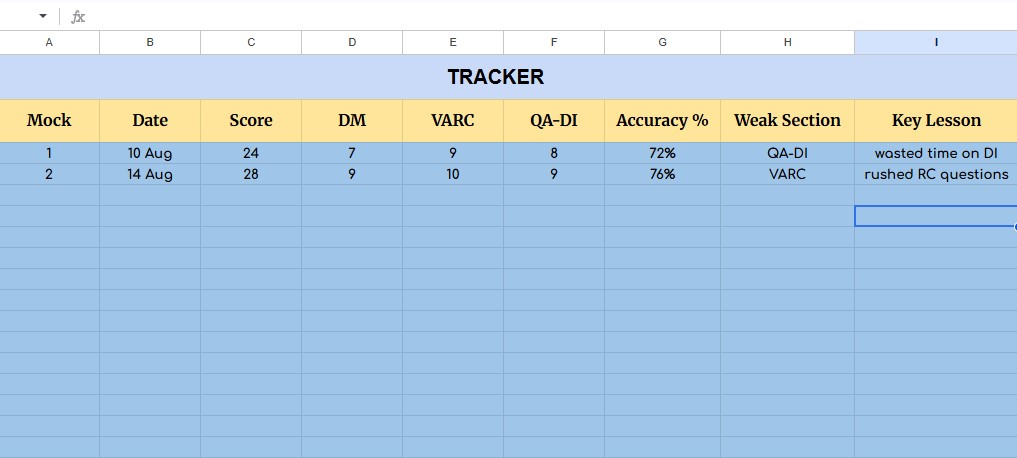
Tracking your mock performance consistently can make a big difference in improving your strategy . Many students use productivity tools like Notion or Google Sheets
While you can use any system that works best for you, maintaining a basic tracker helps you monitor your scores, accuracy, and recurring mistakes across multiple mock tests. To make things easier, here is a simple mock performance tracker template you can use as a reference while analysing your mocks.
Tracking performance consistently is essential for improving mock scores.
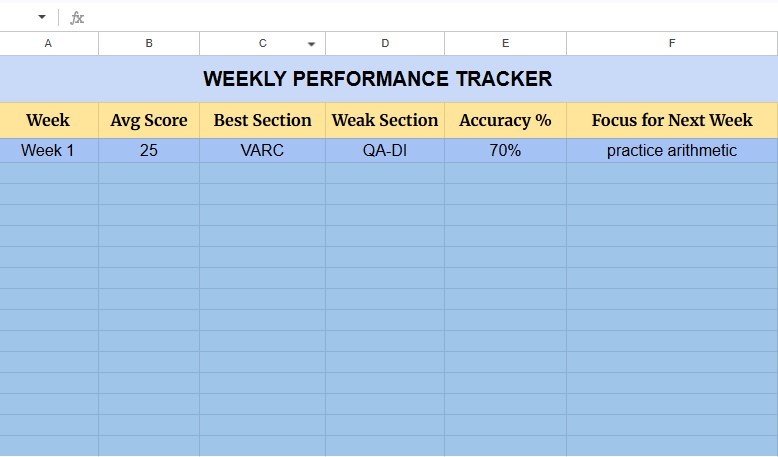
Instead of tracking time per section every mock, students can review weekly patterns.
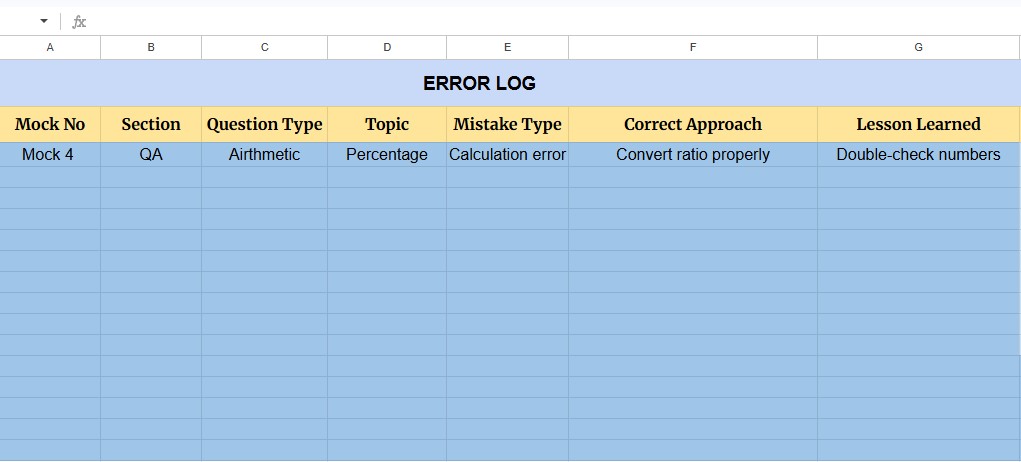
An error log helps prevent repeating mistakes and reviewing this log regularly helps improve decision-making during future mocks.
Techniques to Attempt Mock Tests Properly
Mock tests should always be attempted with a clear strategy.
Follow a Section Strategy : Decide in advance the order in which you will attempt sections. A consistent strategy reduces confusion during the exam.
Practice Question Selection : Not every question needs to be attempted.
Focus on:
-
identifying easy questions quickly
-
skipping time-consuming problems
-
returning later if time allows
Good question selection can significantly improve scores.
Simulate Real Exam Conditions : Always attempt mock tests in conditions similar to the actual exam.
This means:
-
completing the test within the official time limit
-
avoiding distractions
-
not pausing the test
This helps develop mental endurance and exam focus.
Common Mistakes to Avoid While Giving Mocks
Many students make mistakes that reduce the effectiveness of mock tests.
Avoid these common errors:
-
Taking mocks without analysing them
-
Attempting too many questions without focusing on accuracy
-
Ignoring weak sections
-
Taking mocks casually without exam-like discipline
Mocks should always be treated as practice for the real exam environment.
Mock Strategy for the Last 15 Days Before XAT
The final phase of preparation should focus on consistency and strategy stability.
-
Take full-length mock tests regularly
-
Follow the same section order in every test
-
Practice time management carefully
-
Focus on improving accuracy rather than increasing attempts
Avoid experimenting with new strategies during this stage.
Instead, develop a fixed routine that you will follow on exam day.
For example:
-
Decide the order of sections
-
Decide how much time you will spend on each section
-
Decide how you will approach difficult questions
Following the same routine repeatedly ensures that when you enter the exam centre for the Xavier Aptitude Test, you already have a tested strategy that works for you.
Preparing alone can often lead to confusion about strategy and mock analysis. If you want a clear preparation roadmap instead of random practice, join the CATKing XAT preparation program where you get expert strategy sessions, advanced mock tests, and detailed performance analysis to maximise your XAT score.
Frequently Asked Question
1. How should I analyse XAT mock tests effectively?
Start by reviewing your time distribution, accuracy, and question selection. Identify whether mistakes were due to concepts, misreading, or poor strategy. Focus on improving weak areas rather than just checking your score. Consistent mock analysis helps build a strong exam strategy.
2. How many mock tests are enough for XAT preparation?
Aspirants should ideally take 10–20 full-length mock tests before the exam. The focus should not only be on attempting mocks but also on analysing each test in detail. Regular mocks improve time management and decision-making skills. Quality analysis matters more than quantity.
3. Why is mock analysis more important than mock tests?
Mock tests show your current level, but analysis helps you improve. Without analysis, you may repeat the same mistakes in every test. Understanding why you got questions wrong is crucial for score improvement. Analysis turns practice into actual progress.
4. How can I improve accuracy in XAT mocks?
Focus on solving fewer questions with higher accuracy rather than attempting everything. Identify patterns in your mistakes and avoid guesswork without elimination. Regular revision of concepts and practicing similar questions helps improve accuracy. Accuracy directly impacts your percentile due to negative marking.
5. What is the best way to analyse Decision Making questions?
Review each caselet carefully and check if your answer considered all stakeholders. Avoid extreme or biased options and focus on practical, ethical solutions. Compare your logic with the correct answer explanation. Regular practice of past XAT DM sets improves performance significantly.
6. How do I track progress across multiple mock tests?
Maintain a simple tracker using Excel or a notebook to record scores, accuracy, and weak areas. Track trends over 10–15 mocks instead of focusing on a single test. This helps identify consistent strengths and weaknesses. Data-driven preparation improves overall performance.
7. What mistakes should I avoid while taking XAT mocks?
Avoid taking mocks casually without proper analysis. Do not attempt too many questions at the cost of accuracy. Ignoring weak sections can also hurt your overall score. Treat every mock like the actual exam for better results.
8. How much time should I spend analysing one mock test?
Ideally, spend 2–3 hours analysing each mock test thoroughly. Review every incorrect and skipped question to understand the correct approach. Identify time-consuming questions and improve your strategy. Deep analysis leads to better performance in future mocks.
9. When should I start taking full-length XAT mock tests?
Start with sectional tests early in your preparation and begin full-length mocks by the second month. Increase the frequency of mocks in the final month before the exam. Regular practice helps build exam temperament. Early exposure reduces exam-day pressure.
10. How to improve question selection in XAT mocks?
Practice identifying easy and moderate questions quickly during mocks. Avoid spending too much time on difficult or lengthy problems initially. Mark tough questions for later review if time permits. Smart question selection can significantly boost your score.
XAT Previous Year Papers
XAT Toppers strategy video guide
List of Top Colleges Accepting XAT




Comments are disabled for now