
CET stands for common aptitude test. CET Blood Relation is important and useful in logical section. This topic is an integral part of many competitive exams. An aspirants could except few questions from this topic. As Logical reasoning section contain a total of 20 questions and out of that few questions are from Seating Arrangement. A Logical Reasoning & Data Interpretation contains 30% weightage in CET exam.
Questions from this section are frequently asked as per pervious paper analysis. To solve the questions based on Blood Relation in CET, candidates first have to understand the concept of family tree and blood relationship. Blood Relations questions requires a candidate to develop a logical approach towards solving questions.
We can solve Blood Relation questions easily if candidate pay attention while reading the question. Read the article to know more about some tricks, concepts, and solved sample questions. Generally, CET Blood Relations questions are asked about the biological connections from paternal and maternal side.
Blood Relation: Definition and Basic Concepts
The questions related to blood relations involve various family members and their relations. The questions provide some information related to the different members of the family. And the candidates are requires to identify the relationship. Biological relationship between those particular members. The blood relations questions might be of different forms. Which are explained in detail below.
Blood Relations: Type of Questions
The blood relation questions have several variations to test the understanding and interpretation capabilities of the candidates. The question types are divided into three CETegories such as:
- Direct conversation-based questions
- Puzzle based questions
- Symbols (or Code) based questions
Though the questions have these aforementioned types, solving the problems and the ultimate aim of the questions always remain unchanged. Whatever the questions are, the candidates are always required to identify. The relationship between two particular entities.
The types can further be classified as:
- Single person blood relation and
- Mixed blood relation
The single person blood relation involves the relationship between two people only. The questions can be either direct or indirect. In mixed-blood relation, the relation between several members and hierarchy are considered. The different variations of questions are explained below along with an example each.
Direct Conversation Based Questions
In direct conversation-based questions. A problem statement (in the form of conversation) as shows and a particular relation. Which is asked from the conversation. In general, these questions are single person blood relation types i.e. involving the relationship between two persons only. So let’s see an example that will illustrate this better.
For Example 1: Showing a photo of a man, Pinki says,” His mother’s only daughter is my mother”. How is Pinki related to the man in the photo?
Solution:
Analysing the sentence, it can be deduced. That Pinki’s mother is the sister of the man in the photo. So, the man is the Uncle of Pinki or Pinki is the niece of that man.
Puzzle based questions of blood relation.
In this type, usually set of information is as shows up with series of questions. And with the help of this info. you need to answer those questions. The technique to solve them is family tree diagrams.
You can draw tree diagrams in the following fashion.
- Use vertical lines to represent parent-child relationships.
- Horizontal lines like <-> to denote marriages and dashed lines to represent sibling relationships. Apart from that, a sibling relationship can easily establish. If they share the same root.
- You can also add gender differentiation to it by using a + sign for male and – sign for female.
- You can use (?) for the information that has not been provided to you.
Symbols (or Code) based questions of blood relation.
In these types of questions, relationships are represent with the help of specialised codes or representations such as +,-,*,$, percent, and so on. After that, the candidate must examine some provided codes in order to identify the relationship between a group of people or to demonstrate a given relationship in coded form.
For Example 3: Consider the following statements and answer the given question.
If L + M => L is the husband of M,
L / M => L is the sister of M and
L + M => L is the son of Y, then
How is W and Z related from the following statement: W * X + Y / Z?
Solution: This can be solved by dividing the question and solving it from left to right. Now a simple diagram can help. Hence, Draw diagram to mention the gender and their relations as shows below:

Thus, it is easily examine that W is the nephew of P.
Blood Relations For CET: Tips & Strategies
As the topic is repeated every year in the CET exam, the candidates are suggested to be thorough with the basics and other related concepts to increase their chances of scoring more in the exam. So Here are some important tips and strategies are as shows to help the CET aspirants ace the blood relation question with ease.
Subsequently, There are two CETegories of blood relatives:
- Paternal blood relation
- Maternal blood relation
Paternal blood relation
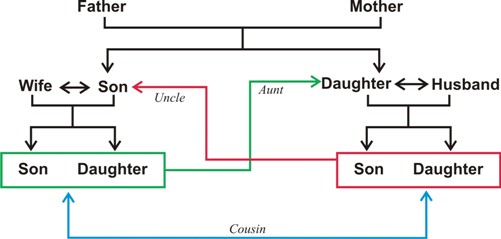
This type of blood relationship can be divided into three CETegories. For instance those are Father’s previous generations include great grandfather, great grandmother, grandfather, grandmother, and so on. Father’s parallel generations include uncles (brothers), aunts (sisters), and so on. For Example Future generations of fathers, sons, daughters, grandsons, granddaughters
Maternal blood relation
This CETegory of blood relations can be further divided into three CETegories. For instance those are Maternal great grandfather, maternal great grandmother, maternal grandfather, maternal grandmother, and other maternal generations. Like For example Maternal uncles, maternal aunts, and other relatives of the mother. For example Sons, daughters, grandson’s, granddaughter’s, and other future generations of mothers
Paternal side |
Maternal side |
In-laws side |
| Paternal Grandfather= Father’s Father | Maternal Grandfather= Mother’s Father | Wife’s grandmother= Grand Mother–in–law |
| Paternal Grandmother= Father’s mother | Maternal grandmother= Mother’s mother | Wife’s grandmother= Grand Father–in–law |
| Uncle= Father’s brother | Maternal uncle= Mother’s brother | Wife’s brother= Brother–in–law |
| Aunt= Father’s sister / Uncle’s Wife | Aunt= Mother’s sister / Maternal Uncle’s Wife | Wife’s sister= Sister–in–law |
| Cousin= Uncle’s/ Aunt’s children | Cousin= Maternal uncle’s/ Aunt’s children | Wife’s Mother= Mother–in–law |
| Wife’s Father= Father–in–law | ||
| Son’s Wife= Daughter–in–law |
Questions to practice blood relation.
For Example: In a family, there are six members- A, B, C, D, E and F. A and B are a married couple, A being a male member. D is the only son of C, who is the brother of A. So E is the sister of D. B is the daughter-in-law of F, Hence find whose husband has died.
How F has related to A?
- Mother
- Sister-in-law
- Sister
- Mother-in-law
- None of these
How is E related to C?
- Daughter
- Aunt
- Cousin
- Sister
- Mother
Who is C to B?
- Brother
- Brother-in-law
- Son-in-law
- Nephew
- None of these
How many male members are there in the family?
- Two
- Three
- Four
- Five
- One
ENROLL IN OUR COURSES NOW!
For CET courses AND For Non-CET courses
Frequently Asked Questions (FAQs)
1. What is the importance of Blood Relation questions in the CET exam?
Blood Relation questions form a crucial part of the Logical Reasoning and Data Interpretation (LRDI) section in CET. The test tests your analytical ability, logical thinking, and clarity in family hierarchies — key skills for management aspirants.
2. How many Blood Relation questions are asked in CET?
Usually, 2–3 questions based on Blood Relations appear in the CET exam every year. However, the exact number may vary depending on the set, especially in puzzle-based or coded logical reasoning sets.
3. What are the types of Blood Relation questions asked in CET?
Blood Relation questions in CET are generally of the following types:
-
Direct Conversation-Based Questions – based on dialogues or statements.
-
Puzzle-Based Questions – involving multiple relationships within a family tree.
-
Symbol or Code-Based Questions – using symbols like +, –, *, / to represent relationships.
4. How can I quickly solve Blood Relation questions in CET?
The fastest way to solve these questions is to:
-
Draw a family tree diagram for clarity.
-
Use symbols (+ for male, – for female) to avoid confusion.
-
Decode relationships step by step instead of reading the whole statement at once.
-
Practice regularly with mock tests and previous year papers to build speed.
5. What are Paternal and Maternal Blood Relations?
-
Paternal Relations: These are from your father’s side, such as grandfather, uncle, or aunt.
-
Maternal Relations: These are from your mother’s side, such as maternal grandfather, maternal uncle, or aunt.
Knowing these distinctions is crucial for solving complex family tree questions correctly.
6. Are Blood Relation questions easy or difficult in CET?
Blood Relation questions are generally easy to moderate in difficulty. However, in CET, they are often merged with puzzles or coded formats, increasing the logical complexity. Consistent practice ensures accuracy and quick interpretation during the exam.
7. What are some best tips to master Blood Relation questions for CET 2024?
-
Understand the family hierarchy (e.g., grandparents → parents → siblings → children).
-
Avoid assumptions; rely only on the information given.
-
Visualize relationships instead of memorizing them.
-
Time yourself when solving to improve exam efficiency.
-
Use mock tests and LRDI sectional tests for hands-on practice.
8. What resources or books can I use for Blood Relation preparation?
You can refer to:
-
A Modern Approach to Logical Reasoning by R.S. Aggarwal
-
How to Prepare for Logical Reasoning for CET by Arun Sharma
-
CETKing’s LRDI Sectional Mocks and Concept Videos for targeted Blood Relation practice.
How helpful did you find this article?
Thanks for the feedback! Your rating helps us improve future digests.
